
A 3D rendering engine built from scratch in C++ using OpenGL. It allows loading models in multiple formats via Assimp, applying different types of lighting and materials, rendering with normal mapping, and controlling a free camera interactively. The entire scene configuration is managed in real-time through an ImGUI interface.
🎥 Video Demo
Watch demonstration on Google Drive
🚀 Key Features
- Model Loading: Supports multiple formats via the Assimp library
- Phong Lighting: Configurable point and directional lights
- Normal Mapping: Surface detail without additional geometry
- Rendering Modes: Fill, wireframe, and fill with normal mapping
- Texture/Material Rendering: Selectable in real-time
- Interactive Interface: Dropdown menus powered by ImGUI
- Free Camera: WASD movement + mouse look, panning, and pitch control
🛠️ Tech Stack
- C++: Main language
- OpenGL: Graphics API
- GLFW: Window and input management
- GLM: Vector and matrix mathematics
- Assimp: 3D model loading and import
- ImGUI: Interactive user interface
- GLSL: Vertex and fragment shaders
🏗️ Architecture
The design follows an object-oriented scheme with well-defined responsibilities. The class diagram summarizes the main relationships:
Renderer  ◆── ShaderHandler   (Composition: Renderer creates and owns ShaderHandler)
Renderer  ◆── Camera
Renderer  ──▶ Light (N lights in vector)
Renderer  ──▶ ModelManager
ModelManager  ◆── Model [1..N]
Model         ◆── ModelMesh [1..N]
FileLoader  · · ▶  Renderer   (Usage for file loading)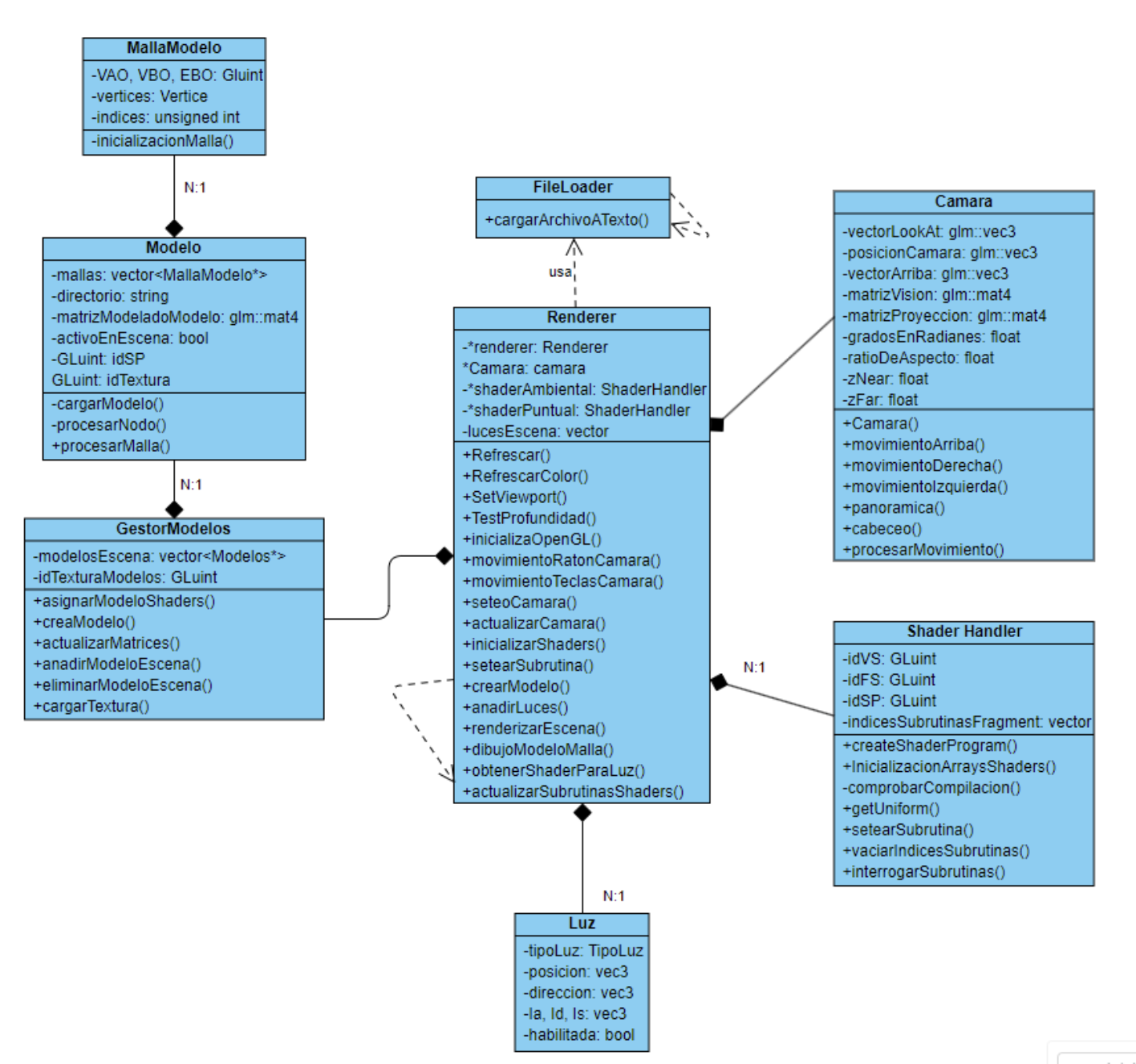
Renderer
The core class of the system. It manages the rendering cycle, shaders, camera, models, and lights. It is a Singleton (GetInstancia()), allowing access from anywhere in the application (including ImGUI and input callbacks).
ShaderHandler
Internal composition of Renderer. Responsible for:
- Compiling and linking GLSL programs (
createShaderProgram) - Initializing and managing VAOs/VBOs (
InicializacionArraysShaders) - Checking shader compilation errors (
comprobarCompilacion) - Managing fragment subroutines to switch between rendering modes
Camera
Stores view and projection matrices (glm::mat4) and exposes methods for each type of movement: translation (movimientoArriba, movimientoDerecha), panning (panoramica), and pitch (cabeceo). Processes mouse and keyboard input via procesarMovimiento.
ModelManager → Model → ModelMesh
Three-level composition hierarchy:
| Class | Responsibility |
|---|---|
| ModelManager | Maintains a vector of pointers to Model, assigns texture IDs, and delegates rendering |
| Model | Loads the model via Assimp, stores meshes, model matrix, texture, and shader ID |
| ModelMesh | Contains GPU data: VAO, VBO, EBO, and vertices/indices for each mesh |
Light
Represents a light source in the scene. The type is differentiated by the TipoLuz enum, and each type has its own constructor. Stores position, direction, ambient/diffuse/specular components, and enabled status.
💡 ImGUI Interface
The interface is built in main with dropdown menus that allow scene manipulation without touching code:
ImGui::SetNextWindowSize(ImVec2(300, 140));
if (ImGui::Begin("Main Menu", NULL, ImGuiWindowFlags_NoCollapse)) {
    if (ImGui::BeginMenu("Add")) {
        if (ImGui::MenuItem("Add Point Light"))       popupPointLightOpen = true;
        if (ImGui::MenuItem("Add Directional Light")) popupDirLightOpen = true;
        if (ImGui::MenuItem("Add Model"))             popupAddModel = true;
        ImGui::EndMenu();
    }
    if (ImGui::BeginMenu("Change Model Color")) {
        if (ImGui::MenuItem("Texture"))   Renderer::GetInstancia()->setTextureColorCalculation();
        if (ImGui::MenuItem("Material"))  Renderer::GetInstancia()->setMaterialColorCalculation();
        ImGui::EndMenu();
    }
    if (ImGui::BeginMenu("Change Visualization Mode")) {
        if (ImGui::MenuItem("Wireframe"))                  Renderer::GetInstancia()->setRenderModeWireframe();
        if (ImGui::MenuItem("Fill"))                       Renderer::GetInstancia()->setRenderModeFill();
        if (ImGui::MenuItem("Fill with Normal Mapping"))   Renderer::GetInstancia()->setRenderModeFillNormalMap();
        ImGui::EndMenu();
    }
}
Popup actions for adding lights or models propagate data directly to Renderer via its Singleton instance.
🔦 Normal Mapping
Normal mapping is implemented at the shader level by transforming normals to tangent space. Changes affect:
- Model Loader (Assimp): Retrieving tangential attributes alongside vertices, normals, and UVs.
Renderer::dibujoModeloMalla: Passing tangent variables to the vertex shader.- GLSL Shaders: Calculating lighting in tangent space using the normal map texture.
The system checks in ModelManager::creaModelo that the normal map path is not empty before loading it, as the diffuse texture and normal map are independent:
void PAG::GestorModelos::creaModelo(const char* path, glm::mat4 modelMatrix,
    std::string texturePath, std::string normalPath, float brightness,
    glm::vec3 ambientColor, glm::vec3 diffuseComponent, glm::vec3 specularExponent)
{
    Modelos* model = new Modelos(path, modelMatrix, brightness,
                                  ambientColor, diffuseComponent, specularExponent);
    if (!texturePath.empty()) {
        model->setIdTextura(idTexturaModelos == 1 ? 2 : idTexturaModelos);
        cargarTextura(texturePath);
    }
    if (!normalPath.empty()) {
        model->setIdTexturaNormal(idTexturaModelos);
        cargarTextura(normalPath);
    }
    modelosEscena.push_back(model);
}
⌨️ Controls
| Key / Action | Effect |
|---|---|
W | Move Up |
S | Move Down |
A | Move Right |
D | Move Left |
| Left Click + Mouse | Free Camera Rotation |
P | Pan Left |
O | Pan Right |
C | Pitch Left |
X | Pitch Right |
Movement keys only respond while the left mouse button is held down, preventing accidental movement when typing in ImGUI popups.
🔗 Repository
- GitHub: Carlos-Requena/3D_Viewer
- Main (ImGUI + input):
program/main.cpp - Renderer (normal mapping, L180):
program/Renderer.cpp
🎓 Key Learnings
This project allowed me to:
- Understand the complete OpenGL graphics pipeline (VAO/VBO/EBO, shader compilation, draw calls).
- Implement a Phong lighting system with multi-light support in GLSL.
- Apply normal mapping in tangent space from scratch.
- Integrate ImGUI to build interactive interfaces over OpenGL without additional frameworks.
- Design an object-oriented architecture with composition and Singleton patterns in C++.
- Manage GPU resources (textures, buffers) with IDs and a simplified Object Pool system.